
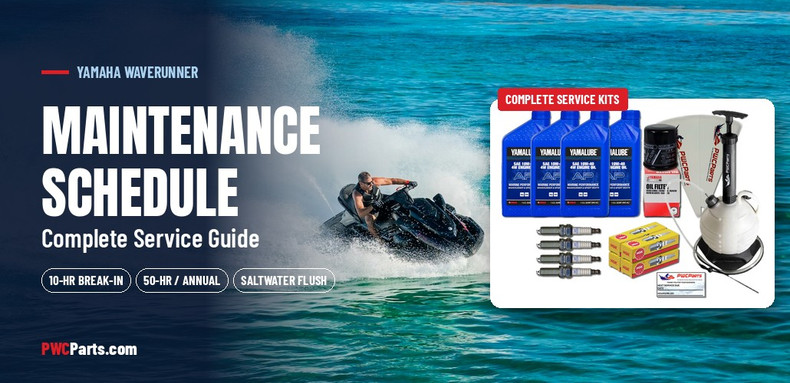
Yamaha WaveRunner Maintenance Schedule: Complete Service Guide from PWCParts.com
A Yamaha WaveRunner will run reliably for a decade or more, but only if you feed it the service it was engineered to expect. The single biggest cause of WaveRunner engine failure isn't hard riding—it's skipped maintenance. Yamaha builds a specific service schedule into every owner's manual for a reason, and once you understand the rhythm of it, keeping up is far easier and cheaper than most riders assume. This guide walks through exactly what your WaveRunner needs and when, whether you run a TR-1 VX, a 1.8L HO/SHO, or a supercharged SVHO.

The 10-Hour Break-In Service
New and rebuilt engines get their first service early—at 10 hours or the end of the first month. During break-in the rings seat and the engine sheds fine metal particles into the oil, so that first oil-and-filter change matters more than any later one. Change the oil with genuine Yamalube 4W, swap the OEM filter, and inspect the intake and cooling passages. Riders who skip the 10-hour service often see it show up years later as scored cylinders. A complete Yamaha WaveRunner maintenance kit bundles the correct oil, filter, and plugs so you aren't guessing on part numbers.
The 50-Hour / Annual Service
This is the backbone of WaveRunner ownership: every 50 hours of runtime or once a year, whichever comes first. Most recreational riders hit the calendar mark long before the hour mark, so treat it as an annual job. At 50 hours you should:
- Change the engine oil and replace the OEM oil filter (part #69J-13440-03-00 on 1.8L engines)
- Inspect and, if needed, replace the NGK spark plugs—LFR7A for SVHO, LFR6A for many HO/SHO builds
- Check the cooling system for salt or sand blockage and flush thoroughly
- Inspect the wear ring, impeller, and intake grate for nicks and cavitation damage
- Grease the pump bearing and intermediate housing where fittings are provided
- Check the spark plug caps, battery terminals, and bilge for water intrusion
For the two most common engine families, PWCParts.com sells purpose-built kits: the SVHO 1.8L oil change kit for 2014+ FX-SVHO, FZR/FZS-SVHO and 2017+ GP1800 models, and the HO/SHO 1.8L kit for 2008+ FX-HO, FX-SHO, VXR, and VXS models. Both include Yamalube 4W, the genuine filter, and a matched set of NGK plugs.
Supercharger and 100-Hour Items (SVHO)
If you ride a supercharged WaveRunner, the schedule adds a critical line item. Yamaha recommends inspecting the supercharger clutch and ceramic washers on a periodic basis—many tuners check them around every 100-hour interval—because a failing supercharger can send ceramic debris straight into the engine. This is the one job where deferring maintenance can turn a modest service into a full rebuild. Non-supercharged VX, HO, and SHO owners don't have this concern, which is one reason those platforms are so beloved for low-cost ownership.

Every Ride: Saltwater Flushing
No maintenance schedule survives saltwater neglect. After every saltwater session, connect a hose to the flush fitting and run the engine for the interval Yamaha specifies—typically 90 seconds to a few minutes—so fresh water clears salt from the cooling passages before it crystallizes. Salt left in the exhaust and cooling circuit is the number-one corrosion accelerator on coastal skis. A two-minute flush is free; a corroded exhaust manifold is not.
Winterization and Off-Season Storage
Before the ski sits for winter, fog the engine, stabilize the fuel, change the oil so acidic used oil doesn't sit against bearings for months, top off or maintain the battery, and add anti-corrosion treatment to the cooling system in freeze-prone climates. Coming out of storage in spring, reverse the process: fresh oil if you didn't change it in fall, a charged battery, and a full pre-launch inspection of the impeller and cooling system.
Keeping Records
Log every service with the date and engine hours. A documented maintenance history protects your warranty, makes troubleshooting faster, and adds real resale value—buyers pay more for a WaveRunner with a clean service book. Stock a spare OEM oil filter and a set of plugs so weather never dictates whether you can service on schedule.
Frequently Asked Questions
How often should I change the oil in my Yamaha WaveRunner?
Change the oil and filter every 50 engine hours or once per year, whichever comes first, plus an initial change at the 10-hour break-in point. Most recreational riders reach the annual mark before 50 hours, so an oil change each season is the right cadence.
What spark plugs does my WaveRunner use?
Most 1.8L SVHO engines use NGK LFR7A plugs, while many HO/SHO and naturally aspirated 1.8L engines use LFR6A. Always confirm against your specific model and year, and replace all plugs as a set—the maintenance kits at PWCParts.com include the correct plugs for your engine.
Do I really need to flush after every saltwater ride?
Yes. Flushing clears corrosive salt from the cooling and exhaust passages before it hardens. It takes about two minutes and is the cheapest, most effective way to prevent expensive corrosion damage on a saltwater-ridden WaveRunner.